Leaders of the G7 countries and their invited guests, India, Indonesia, South Korea, Vietnam and Australia, are meeting in Hiroshima over the next few days. The likely topics for discussion include the Ukraine conflict, growing Chinese dominance and the threat to Taiwan as well as issues surrounding supply chains and economic and energy security. The prominent attendance of India, a country that chairs the G20 this year, is highlighted as likely to shine a spotlight on the developing world. However, many have asked why the focus of the summit is background noise, rather than on the nuclear threat signaled by North Korea's recent nuclear tests and missile launches.
Giorgia Meloni, Italy's far-right Prime Minister, has dismissed criticism from Canada's Prime Minister Justin Trudeau over her stance on LGBTQ+ rights. At a G7 Summit press conference, Meloni claimed that Trudeau had fallen "victim" to "fake news" and propaganda, with the accusations not "correspond[ing] to reality". Last month, Meloni's government told Italian city halls to stop automatically registering both parents in same-sex couples as parents, limiting recognition to only the biological parent. LGBTQ+ rights activists held rallies in opposition to the move, calling it homophobic.
The G7 summit in Hiroshima has ended with discussions focusing on the Ukrainian war and the dominance of China. They also focused on challenges facing developing economies, including Brazil, Vietnam, Comoros and India. Ukrainian President, Volodymyr Zelenskyy made headlines during his time the summit. He was present in the session on Ukraine where it was revealed he had spoken with Canadian Prime Minister Justin Trudeau. His itinerary for the rest of the day included visiting the Peace Memorial Park and the museum in Hiroshima to remember the atomic bombing of the city. Zelenskyy continues to make the rounds of G-7 leaders. Earlier on the second day of the summit, India's Prime Minister Narendra Modi met the president on the margins of the summit for the first time since Russia's invasion of the Ukraine and shared images of their encounter to his Twitter page.
The final day of the Group of Seven (G7) summit has passed in Hiroshima, with delegates including Ukraine's President Volodomyr Zelenskyy discussing the war, China’s dominance and the issues faced by the Global South. Joining the leaders were a number of key Asia-Pacific figures such as the Indian, South Korean, Indonesian and Australian prime ministers. The triennial met throughout the summit, while Ukrainian President Volodymyr Zelenskyy took some time off to visit Hiroshima’s Peace Memorial Park and Museum. President Joe Biden met with Zelenskyy, Ukrainian Prime Minister Fumio Kishida, South Korean President Yoon Suk Yeol and Japanese Prime Minister for talks. The G7 laid out a common de-risking path on China, while India's Narendra Modi commented that he would “amplify concerns of the Global South” at the summit.
Italian PM Meloni rejects criticism from Trudeau over LGBTQ rights
CBC
23-05-21 02:20
Italian Prime Minister Giorgia Meloni has dismissed criticism about her government's stance on LGBTQ rights from Canadian Prime Minister Justin Trudeau at the G7 Summit. Trudeau had expressed concern on Canadian television before private talks that he hoped to have with Meloni, but she rejected his remark as inaccurate and the result of "fake news". Meloni's government came under fire earlier this year for urging city halls to stop recognising both parents in same-sex relationships, which activists criticised as homophobic.
The Ukraine conflict was at the forefront of G7 meetings in Hiroshima, Japan, over the weekend. Ukrainian President Volodymyr Zelenskyy was among the invitees to the meetings, which discussed China's growing dominance and issues affecting the so-called "Global South." Canadian Prime Minister Justin Trudeau expressed the need for a "resilient and diversified" approach to supply chains, while UK Prime Minister Rishi Sunak commented on the summit's significance for consolidating peace. Meanwhile, Japan's Prime Minister Fumio Kishida called for the issue of nuclear weapons to be discussed openly, and said it was "historically significant" for the G7 leaders visiting the Peace Memorial Museum to publish a focus on nuclear disarmament – known as the Hiroshima Vision. The G7 summit heralded a number of warm bilateral meetings, concluding with talks between Ukrainian President Volodymyr Zelenskyy and South Korean President Yoon Suk Yeol on the conflict on Sunday afternoon.
The Group of Seven (G7) summit in Japan has ended, with discussions centring around the Ukraine war, China’s growing dominance and support for the “Global South”. According to a communique, the G7 nations have agreed to support public-private initiatives to swerve China's “belt and road” initiative, to implement measures to counter state-backed “malicious cyber activities”, and to decarbonise energy systems by the end of the century. The G7 also signed a declaration committing to the protection of international maritime regulations, including the peaceful resolution of maritime disputes, navigation rights, and safety along sea lanes. G7 leaders expressed concern over the situation in the East and South China seas. The summit also saw the invitees from Indonesia, South Korea, India and Australia discuss issues such as Ebola, the impact of Brexit, terrorism and trade. President Zelenskyy of Ukraine was in the spotlight throughout the summit.
Italy's Prime Minister Giorgia Meloni has pledged to back the recovery of areas in northern Italy damaged by recent floods which are estimated to have cause damage costing billions of euros and left 14 people dead. Speaking after touring areas around the city of Ravenna, Meloni, who left the G7 summit early to visit affected areas, stated that she would find the resources needed to aid recovery efforts and may call upon the European Union's Solidarity Fund. Agricultural regions, including fruit producers, have also been badly affected.
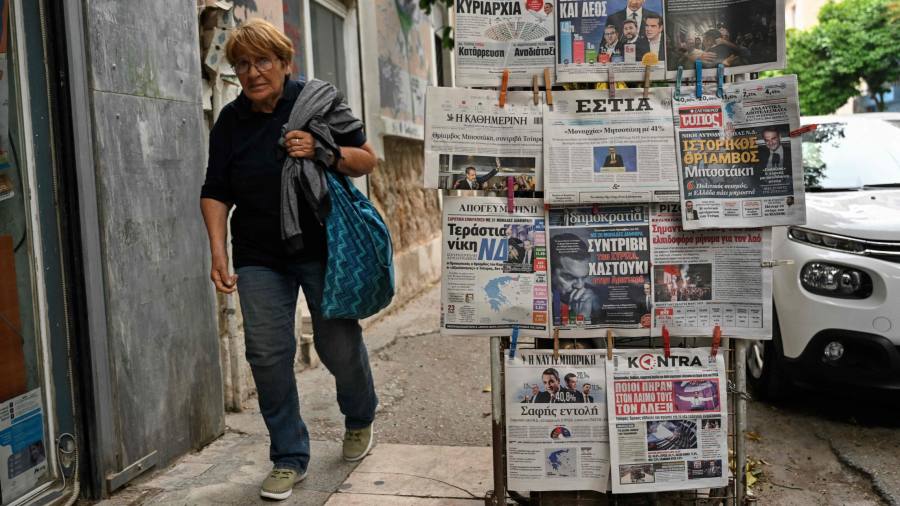
The differential between Greek and Italian government bond yields has widened to its highest level since 1999 after Prime Minister Kyriakos Mitsotakis secured an election victory. Investors believe Athens is now less risky than Rome. Interest payments for 10-year benchmark Greek debt fell by more than 0.15 percentage points to 3.85% on Monday, reflecting the positive response to Mitsotakis just missing out on securing a parliamentary majority. The move means the spread on Italian bond yields above Greek bond yields is at its widest level since at least 1999.